Innovation Network

AI-enabled innovation capability

Build the capability to turn complex challenges into measurable progress.

Innovation Network helps enterprise and government organisations develop innovation practitioners, facilitators and leaders; solve live challenges; and embed AI, evidence and governance into how work gets done.

The Innovation Capability System

How we work
The Innovation Capability SystemFive method loops arranged from problem to solution to deployment: Design Thinking, Lean, Design Sprint, Agile and Continuous Improvement. The Master Facilitator capability of frame, guide, challenge, align and decide runs across the top. AI-enabled productivity, from research to reporting, and delivery management, from scope to benefits, run underneath.Master Facilitator CapabilityFrameGuideChallengeAlignDecidePROBLEMSOLUTIONDEPLOYMENTEmpathizeDefineIdeatePrototypeTestExperimentTestLearnLean / Lean StartupMapDecideSketchPrototypeTestPlanSprintReviewRetrospectiveMeasureImproveStandardiseReviewContinuousImprovementAI-EnabledProductivityResearchSynthesisIdeationPrototypingTestingReportingDeliveryManagementScopePlanDeliverTrackBenefits

Scroll the diagram sideways, or open it on a larger screen.

  • Design Thinking
  • Lean / Lean Startup
  • Design Sprint
  • Agile (Scrum)
  • Continuous Improvement
  • Master Facilitator Capability
  • AI-Enabled Productivity
  • Delivery Management

Complex problems. Clear decisions. Capable teams.

Working with defence, government, enterprise and higher education

  • UK Ministry of Defence
  • UK Defence Innovation
  • Defence Academy of the United Kingdom
  • Imperial College London
  • UCL
  • London School of Economics

The capability gap

Training is only the beginning.

Organisations invest in courses, then discover that nothing has changed in how work is framed, how decisions are made, how delivery runs or how leaders behave. Knowledge went in. Capability did not come out.

We design for the transfer. Every engagement is built so that learning shows up as behaviour, decisions, practical work and organisational results, and so that the capability stays inside the organisation when we leave.

What we solve
  1. 01

    Live challenges, not hypothetical exercises

    Every programme runs on problems the organisation actually needs solved. Participants leave with progress on real work, not a workbook.

  2. 02

    Evidence of application, not attendance

    Recognition is earned by producing and applying work products in the workplace. Sponsors see what was built, decided and changed.

  3. 03

    Role-based pathways, not one-size-fits-all courses

    Ambassadors, practitioners, facilitators, specialists and leaders share one foundation, then go as deep as their role requires.

  4. 04

    Internal facilitators, not permanent supplier dependency

    We develop the people who can design and run the work themselves. The capability stays when we leave.

  5. 05

    AI embedded throughout, not isolated in a masterclass

    AI supports research, synthesis, prototyping and analysis at every stage, with human judgement, source checking and governance built in.

Pathway explorer

Find your pathway in three questions

Choose a role, a goal and a starting level. You will get a recommended sequence, the taught time, the work products you will produce, the assessment and the recognition available. No email address required.

1. Your role
2. Your primary goal
3. Your current level

The recommendation updates as you change your answers.

Your recommended pathway

Answer the three questions and press Show my pathway. If JavaScript is unavailable, the role-based pathways describe each route in full.

The Innovation Capability Pathway

One connected system, not a course catalogue

Five stages, a common foundation and role-relevant depth. Select a stage to see who it is for, what is produced and how people progress.

Stage 2 · Align

Frame the right challenge

Build the foundation: understand users, frame the challenge properly, generate options, prototype and test the assumptions that matter.

Who it is for

  • Innovation Ambassadors
  • Practitioners
  • Unit teams
  • Internal facilitators

Progression

Apply the process to a workplace challenge to earn Certified Innovation Associate.

The Capability Portfolio

Evidence that learning has moved into work.

Progression on the pathway is based on evidence, application and reflection rather than attendance alone. The Capability Portfolio is where that evidence lives and how sponsors see it.

  1. 01

    Profile

    A diagnostic and learner profile establish where each person starts, which role they hold and what they need to be able to do.

  2. 02

    Prepare

    Before a programme, participants identify the live challenge they will work on and the stakeholders around it. Sponsors confirm it matters.

  3. 03

    Apply

    During and after the programme, the methods are used on the challenge. The work is real, and so is the risk of learning that an assumption was wrong.

  4. 04

    Evidence

    Work products are recorded: the framed challenge, the map, the prototype, the experiment result, the backlog, the roadmap, the facilitation design.

  5. 05

    Reflect

    A short reflective review records what was learned, what would be done differently and what decision the evidence supports.

  6. 06

    Progress

    An assessor reviews the evidence. Recognition is awarded, the next stage is recommended and sponsors see what has been applied.

Courses create knowledge. Applied evidence creates capability.

Examples of evidence participants produce

  • Challenge statements
  • Stakeholder maps
  • Assumption maps
  • Prototypes
  • Experiments
  • Test results
  • Backlogs
  • System maps
  • Improvement plans
  • Delivery roadmaps
  • Adoption plans
  • Facilitation designs
  • Strategic challenge portfolios
  • Benefits and outcome reports

Colours indicate the stage at which each work product is usually produced.

AI across the pathway

AI supports every stage. People own every decision.

AI is embedded in the research, synthesis, prototyping, analysis and planning at each stage, inside the governance your organisation requires.

Aware

  • Guided challenge framing
  • Diagnostic summaries for sponsors

Align

  • Research planning and evidence synthesis
  • Insight generation
  • Ideation and concept development
  • Rapid prototyping
  • Experiment design

Apply

  • Evidence synthesis across interviews and data
  • Rapid prototyping
  • Test analysis
  • Decision pitch drafting
  • Benefits tracking

Deliver

  • User-story and backlog development
  • System mapping
  • Process analysis
  • Risk and stakeholder analysis
  • Change communications
  • Benefits tracking

Sustain

  • Workshop design
  • Output capture
  • Scenario analysis
  • Portfolio decision support
AI enablement for organisations

How engagements work

Diagnose, sprint, embed, transfer

We do not leave clients with inspiration. We leave them with operating capability.

The Innovation Capability System
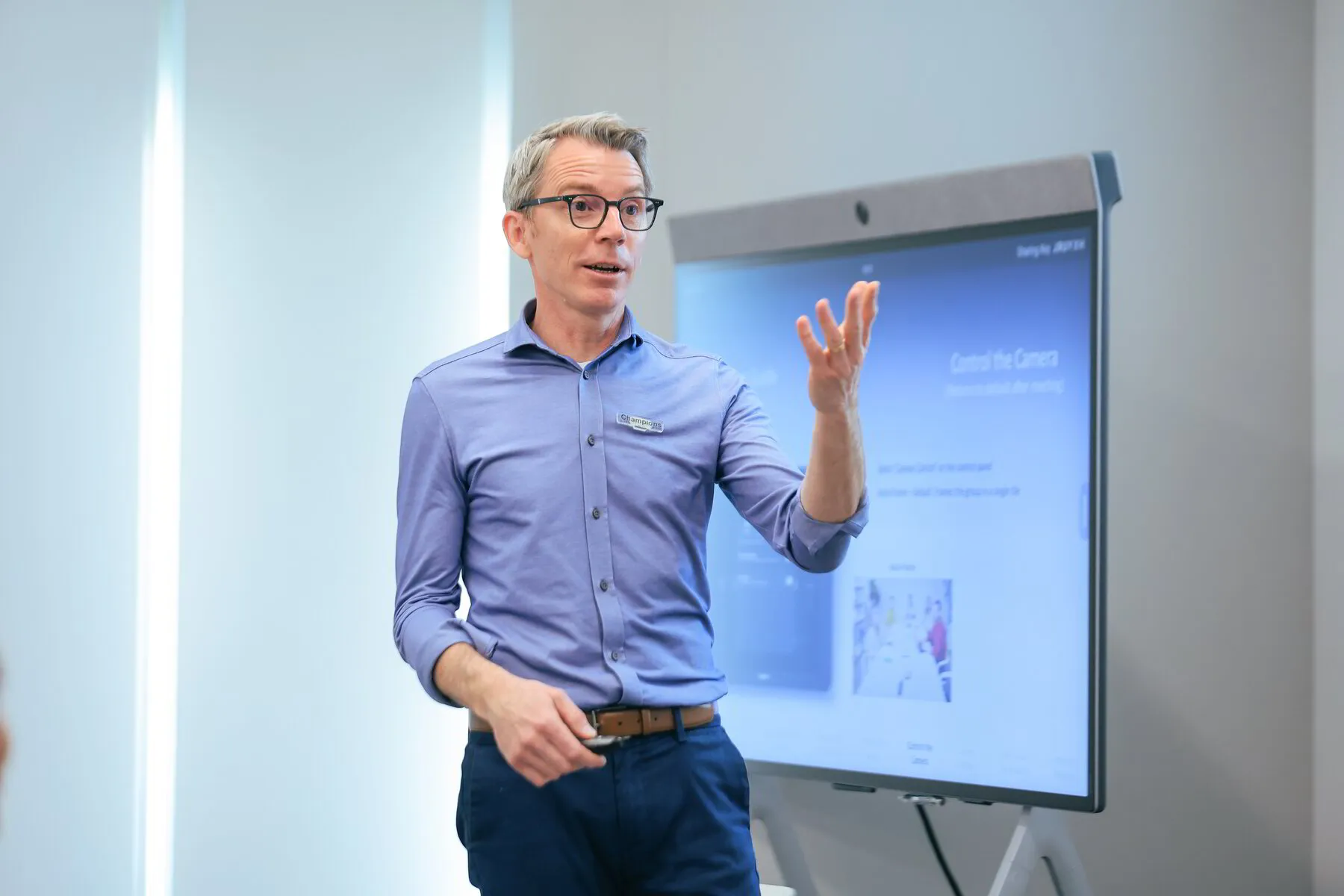
Grant Vernon facilitating a workshop, standing beside a large screen and gesturing to the group
  1. 1Diagnose

    Diagnose workflows, challenges, maturity and capability needs. We start with what the organisation is trying to change, where it is stuck and which roles need which capability.

  2. 2Sprint

    Sprint on live work and priority challenges. Teams learn the methods by using them on problems the organisation needs solved, with AI accelerating the work.

  3. 3Embed

    Embed reusable workflows, tools, playbooks and habits. What worked in the sprint becomes the standard way of working, documented and governed.

  4. 4Transfer

    Transfer capability to internal champions, practitioners and facilitators. The organisation runs the next cycle itself, with our support where it wants it.

Results

What the work produced, and what stayed behind

Case studies follow one structure: context, challenge, intervention, roles and pathway, evidence created, organisational outcome and capability retained internally.

See the evidence

Defence and government

Building innovation capability across UK Defence

UK Ministry of Defence

A structured pathway, funded through UK Defence Innovation and the Defence Academy, that develops innovation practitioners across ranks and functions and turns training into applied work on live defence challenges.

Roles and pathway
Innovation Ambassadors and champions in units and headquarters; Innovation Practitioners leading challenge work
Evidence created
Framed challenge statements from unit teams, Stakeholder and user maps, Assumption maps and prioritised concepts
Capability retained
Certified practitioners and internal facilitators now run sessions within their own units, and an alumni community sustains practice between cohorts. The department can commission programmes for whole units and route people to the right stage of the pathway.
Read the case study

Enterprise, consumer goods

Faster from concept to shelf

A global consumer goods company

A multi-stage programme in agile and lean methods that reset how product teams at one of the world’s largest snack companies moved from concept to launch.

Roles and pathway
Product development and marketing teams; Innovation and portfolio leads
Evidence created
Current-state process assessment identifying bottlenecks, Prioritised concepts with explicit selection criteria, Consumer-tested prototypes
Capability retained
Teams continued to use the agile and lean routines introduced in the programme in their day-to-day product development, and the organisation adopted a culture of testing before committing.
Read the case study

Government

Innovation Ambassadors for a government ministry

A government ministry in the Middle East

A cohort of Innovation Ambassadors trained and coached to break down departmental silos and run structured sprints inside a large national ministry.

Roles and pathway
Innovation Ambassadors drawn from across departments; Department heads as sponsors
Evidence created
Framed cross-departmental challenges, Sprint outputs and tested prototypes, Facilitated decision sessions
Capability retained
The ambassador network remained in place after the engagement, with ambassadors continuing to run sprints and facilitate cross-departmental work.
Read the case study
“One of the best courses I have been on during 17 years in the military.”
Course participant, UK Ministry of Defence. Innovation Processes.

Enterprise deployment

Three ways to deploy the pathway

From a single programme to an enterprise academy run by your own accredited facilitators. The difference is scale, tailoring, live application, coaching, assessment and reporting.

DimensionStandalone programmeOne programme, one cohort, one live challenge eachFacilitated cohortA role-based pathway for a cohort, with sponsored challenges and coachingEnterprise capability academyThe full pathway run at organisational scale, with internal facilitators
ScaleA single cohort of 12 to 24One or more cohorts moving through a pathway over three to nine monthsHundreds of participants a year across roles and business units
TailoringSector examples and organisational context; standard programme designPathway sequence, challenge selection and materials adapted to the organisationA branded academy with the organisation’s roles, language, governance and challenge portfolio built in
Live applicationEach participant brings a challenge from their own workSponsored challenges agreed with senior owners before the cohort startsChallenge portfolio governed by the organisation and linked to strategy
CoachingPost-programme check-inScheduled coaching checkpoints between programmes and through the workplace projectInternal facilitators and coaches accredited to support cohorts, with Innovation Network assurance
AssessmentWorkplace application submitted through the Capability PortfolioAssessed workplace projects and capstones leading to certificationInternal assessors trained and moderated; certification at every stage
ReportingCohort completion and application summaryProgress, evidence and outcome reports to sponsors at each stageAcademy dashboard: participation, evidence, certification, challenge outcomes and benefits
Best forA team or unit that needs a specific capability now, or an organisation testing the approach before committing further.Developing practitioners, facilitators or leaders for a defined part of the organisation with visible results.Organisations building innovation and AI capability as a permanent asset rather than a programme.
Enterprise academies and capability transfer

What capability does your organisation need next?

Tell us about the challenge, the roles involved and the timeframe. We will come back within one working day with a view on where to start.